Spatial Explicit Modeling
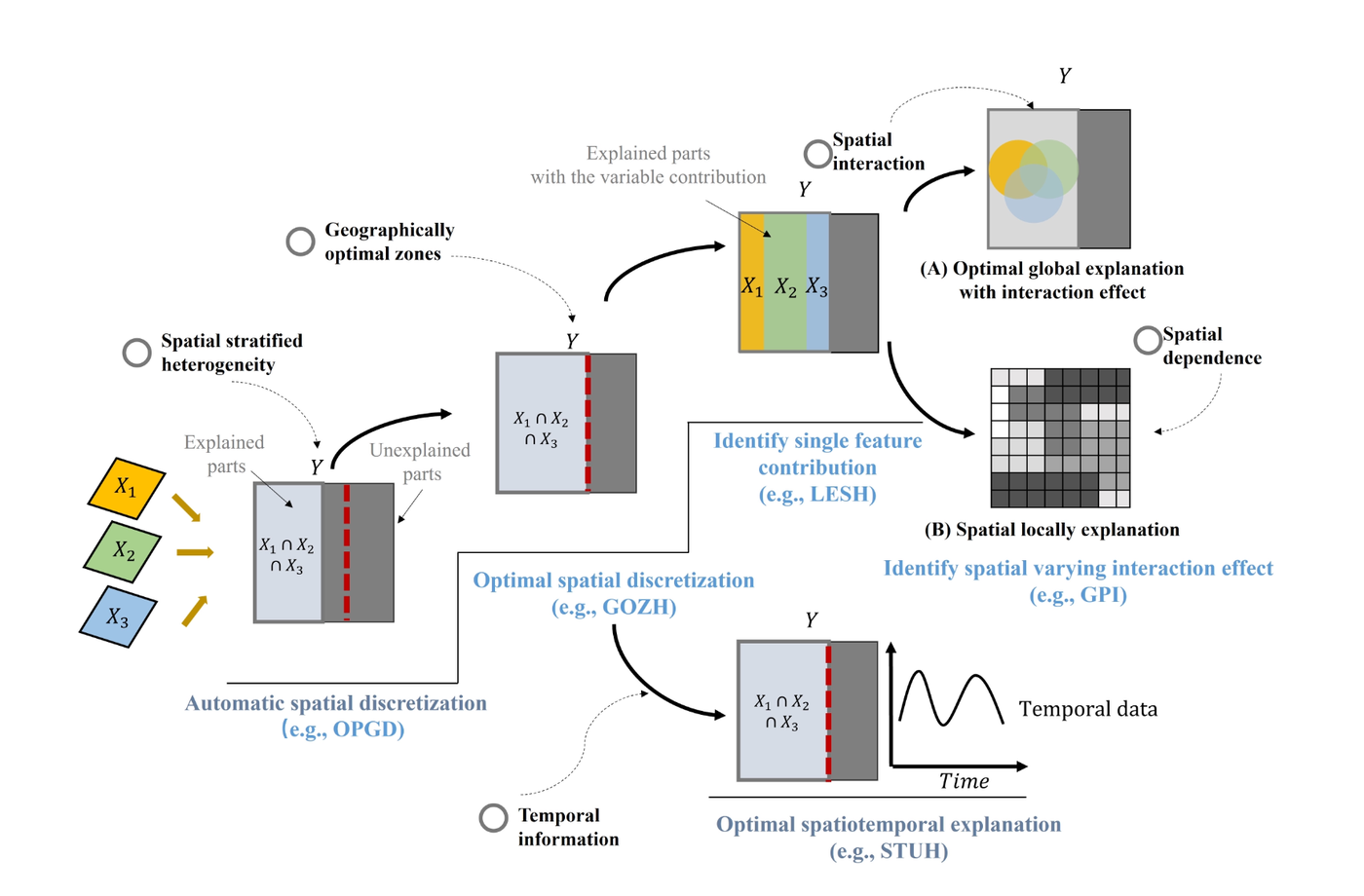
Geographic phenomena are shaped by spatial structure — heterogeneity, dependence, and interaction — yet many statistical and machine learning models treat observations as if they were spatially independent. This research line develops models that explicitly encode geographic structure into prediction and association analysis.
Core contributions include a generalized spatial heterogeneity model for non-stationary interpolation, focal-feature regression kriging that revisits the role of distance in spatial prediction, and methods for measuring univariate effects within interacting geographical patterns. These methods have been applied to soil moisture mapping, aerosol unmixing, traffic accident analysis, and continental-scale environmental assessment.
- Generalized spatial heterogeneity model for interpolation (IJGIS 2023, top-1 most read and top-2 most cited)
- Focal-feature regression kriging (Geographical Analysis 2026)
- Geographically optimal zones-based heterogeneity model for spatial determinants analysis
- Measuring univariate effects in the interaction of geographical patterns (IJGIS 2026)
- Spatio-temporal unmixing with heterogeneity model for MODIS aerosol identification
- Book chapter: Spatial Stratified Modeling in International Encyclopedia of Geography (Wiley-AAG)
- GOZH — Quantifying spatial relationships between geographical variables
- GPI — Measuring spatially varying effects driven by interactions among spatial patterns
- LSEH — R package for quantifying interaction effects between geographical variables